
We live in Foshan, one of China’s major ceramics centers. Every week, buyers ask us the price of a tile. It is almost never the right first question. A tile is not only a size and a price: it is a shade, a caliber, a weight and a package. Here is what we check before recommending an order.
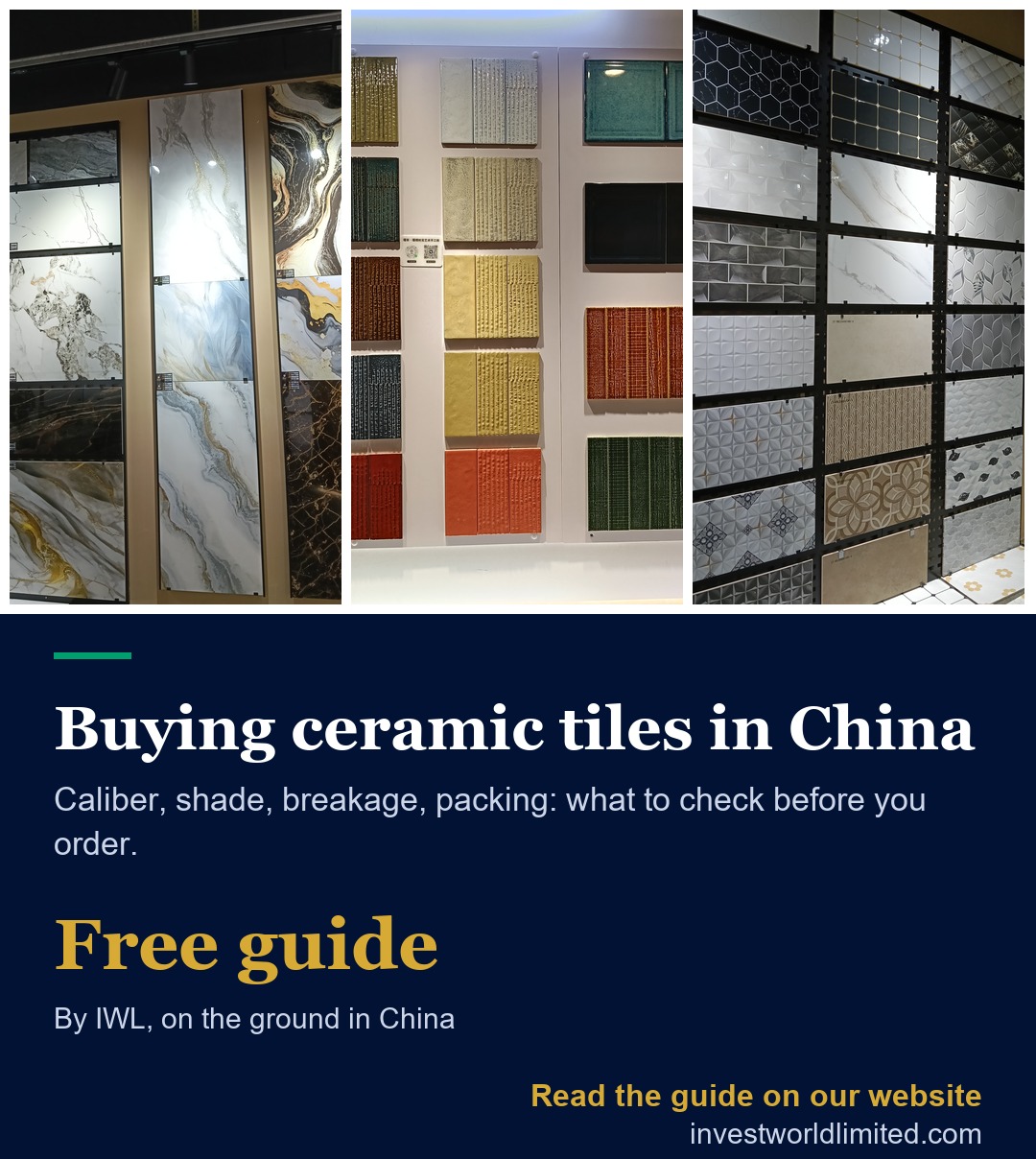
1. Define the product precisely
- The size (for example 600 × 600, 800 × 800, 600 × 1,200 mm or large format) and the thickness.
- The use: indoor floor, wall, outdoor, wet area or heavy traffic.
- The family: porcelain or glazed ceramic; polished, matte or anti-slip finish.
- The grade you expect (first choice) and a reference color, with a physical sample.
Without a written specification, two suppliers will answer with two different products.
2. Technical characteristics to ask for in writing
Ask for a technical sheet and a laboratory test report, not only a photo. Ceramic tile testing follows the ISO 10545 series of standards, and classification follows ISO 13006. Look at:
- Water absorption: porcelain tile has very low absorption (generally 0.5% or less). This is what matters for frost and wet areas.
- Abrasion resistance for floors, and slip resistance for floors that will get wet.
- Frost resistance if the tile is installed outdoors, especially in Canada.
- Flatness and edge straightness, particularly for large formats.
3. Three pitfalls specific to tiles
- Caliber: dimensions vary slightly from one batch to another. Cartons must show the caliber, and two calibers should never be mixed on the same floor.
- Shade: the color changes from one firing to the next. Order the total quantity at once, with a margin, and require the same batch number on every carton.
- Breakage: a tile is heavy and fragile. Add a margin to the quantity and agree in advance who bears the cost of damaged cartons.
4. Packing and transport
Tiles ship by weight and by container, not by square meter. The larger the format and the thicker the tile, the more weight weighs on your freight cost. Check:
- Reinforced cartons, protected corners and wooden pallets treated to the ISPM 15 standard, required for export.
- For large formats, bracing and supports suited to the slab.
- The container loading, preferably with photos before the doors are closed.
To understand how to estimate real freight cost (volumetric weight, air versus sea, forgotten fees), read our guide Shipping from China to Africa: How to Estimate the Real Cost.
5. Inspection before loading
Have the goods inspected before they leave, while problems can still be fixed: dimensions, flatness, shade, surface appearance, carton count, batch numbers. We explain the method in our guide Pre-Shipment Inspection in China.
6. Compare prices on the same basis
A price per square meter only means something if thickness, grade, packing and delivery point (for example FOB) are identical. Always ask for a written quotation that states these four items.
Before you pay
A deposit on a container of tiles is a significant sum. Check the company before you pay: see how to spot a supplier scam and how to audit a Chinese supplier.
How we can help
Our catalogues come from partner manufacturers in the Foshan region: see the General Catalogue: Ceramics & Tiles and the Large-Format Ceramic Slabs Catalogue. If you cannot find your product, describe your need in the custom sourcing request. For a quick question, write to us on WhatsApp or through the contact page.